
RAIN SPINE / A Pleasant Mount
What if a public seat didn't simply survive Vancouver's rain, but made something of it?
Rain as public life
Rain Spine transforms Vancouver rainfall from something public furniture must endure into something it can reveal.
Developed for the 2026 PUBLIC SEAT Design Challenge, the proposal began with Mount Pleasant itself: a neighbourhood shaped by sloping topography, industrial history, buried waterways and the persistent presence of rain.
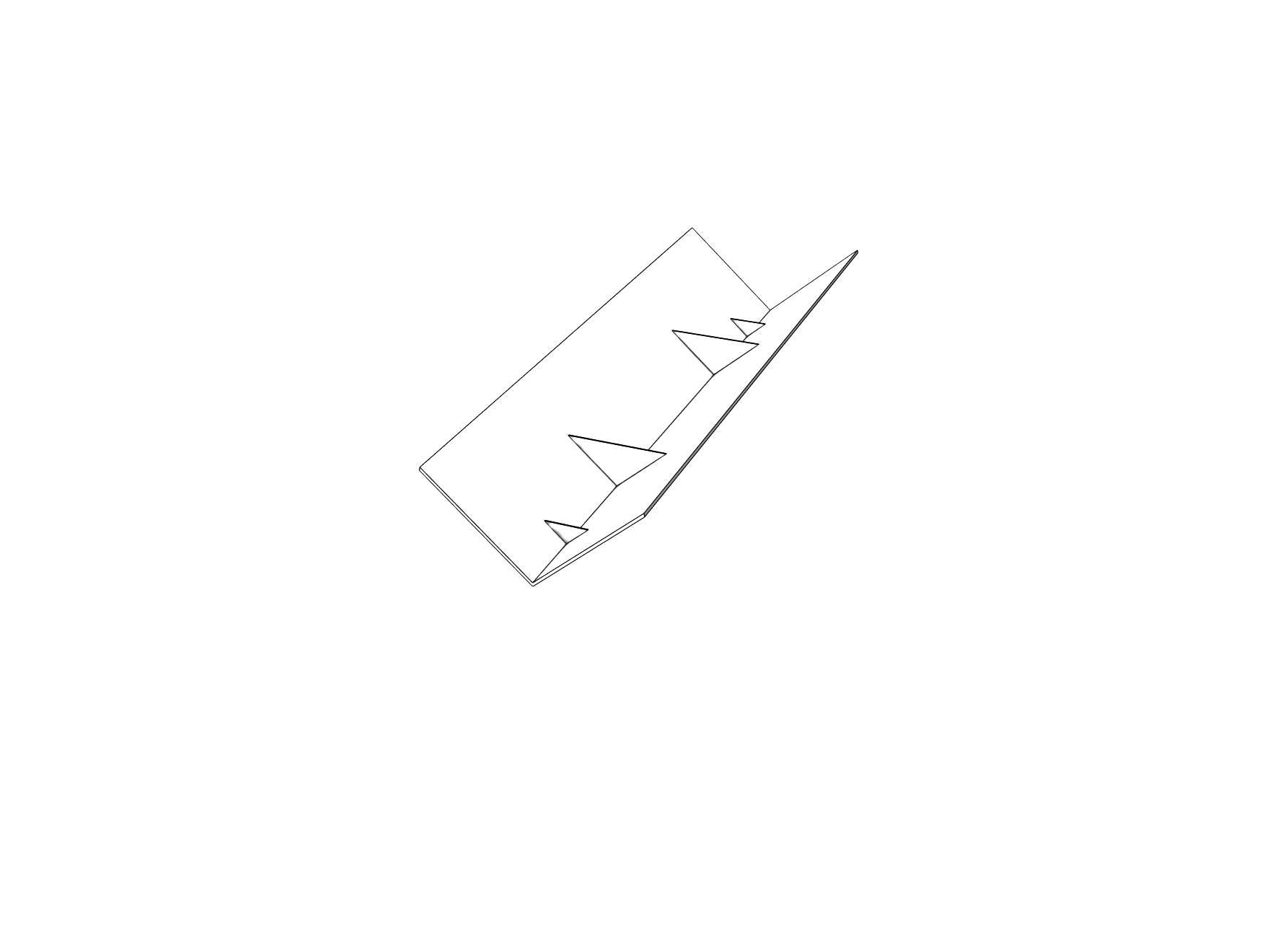
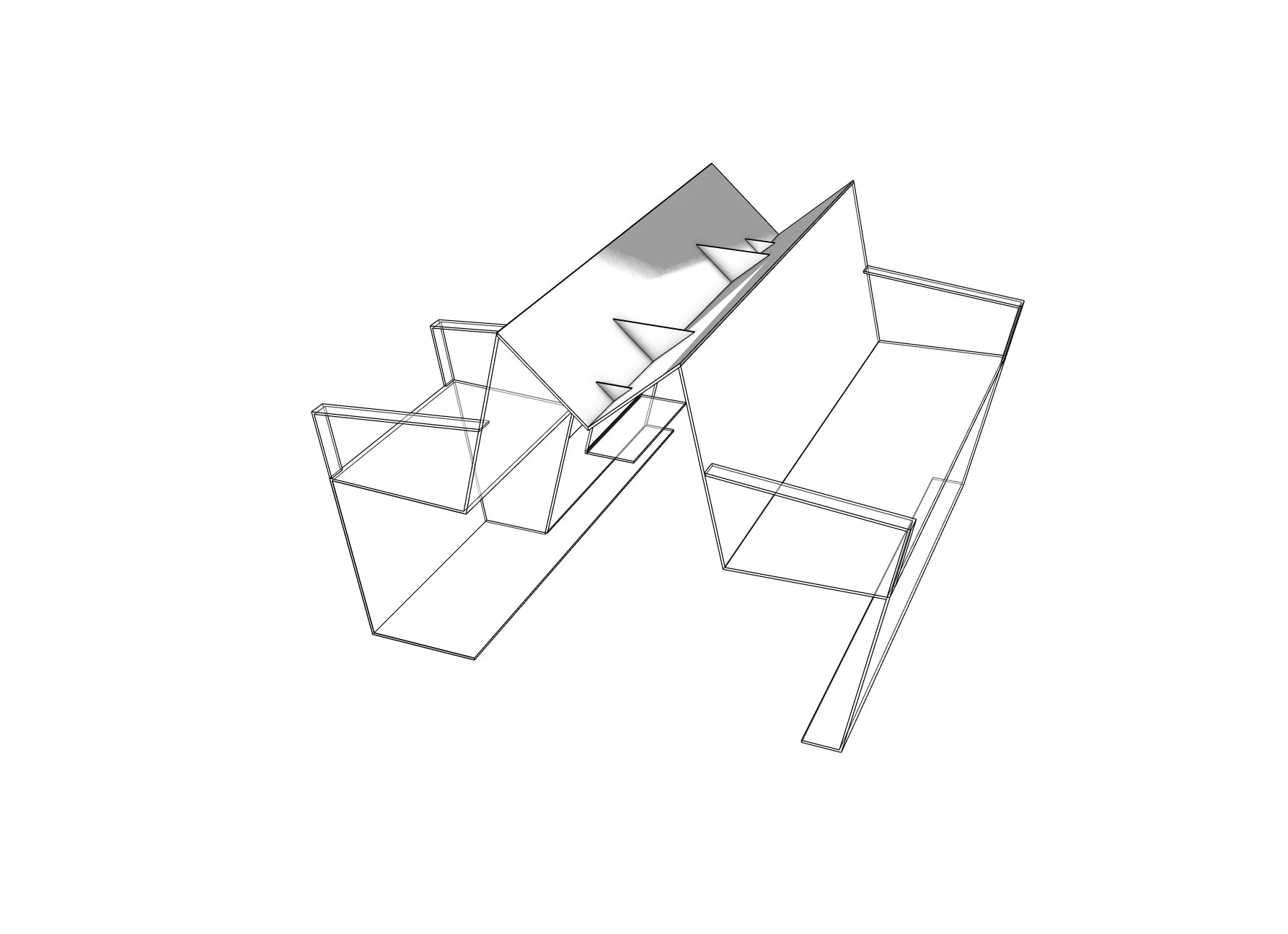
Marine-grade aluminum and warm timber fold around an elevated central spine that catches rainfall, slows it through a series of subtle riffles, and releases it visibly back to the ground.
The result is part seat, part small-scale civic infrastructure.
Supported seating, a leaning perch, companion space and multiple edges allow different bodies and different behaviours to occupy the same compact object; meanwhile, water changes its character with the weather, appearing, moving and disappearing without pumps, plumbing or mechanical systems.
A Pleasant Mount
The folded profile carries a second, quieter reading. Its geometry traces an abstract M for Mount, a central V for Vancouver and its rain spine, and an implied P for Pleasant and Public.
The reference is deliberately secondary: the object should work first as a seat, then reward a closer reading.
That same restraint governs its relationship to place.
Rather than applying neighbourhood identity as graphics or ornament, Rain Spine draws from Mount Pleasant's physical conditions—slope, rainfall, industrial materiality and the memory of Brewery Creek—to produce the form itself.
Designed to be built
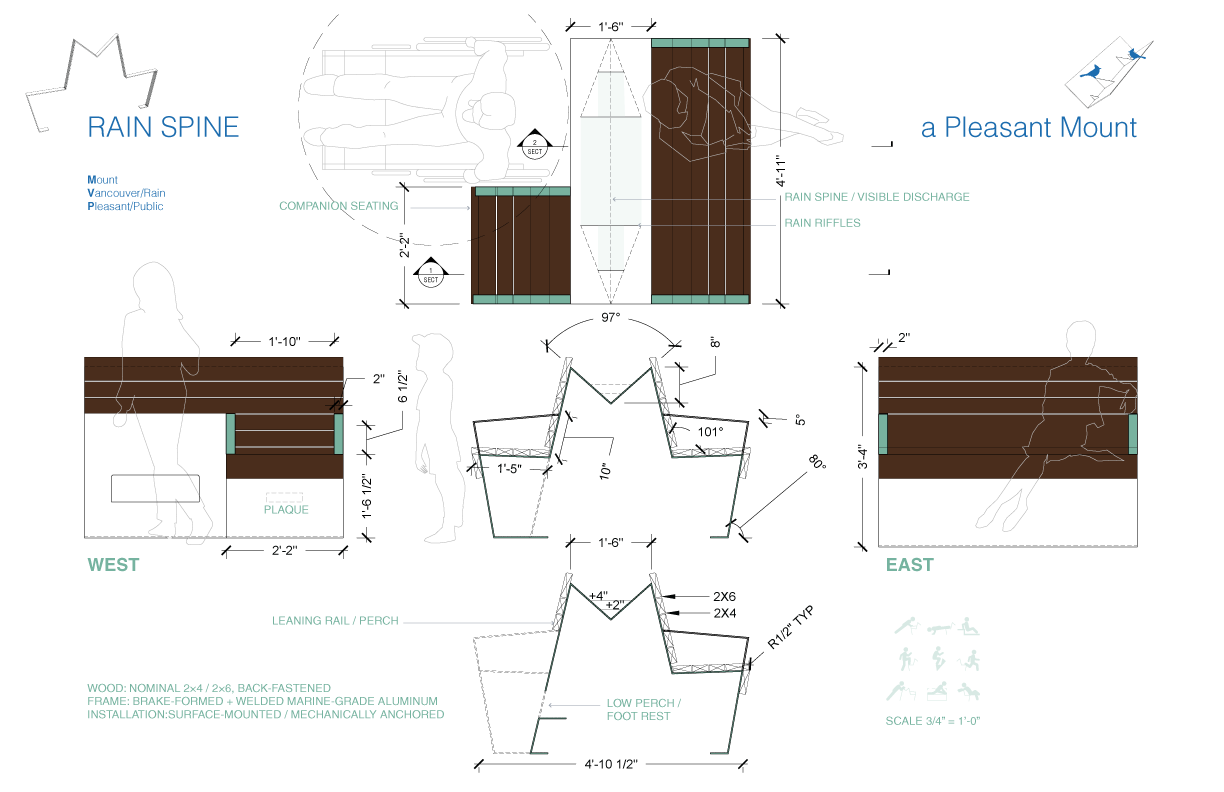
The competition imposed a tight physical and fabrication envelope, so the design was developed as a manufacturable object rather than a conceptual sculpture. A brake-formed and welded marine-grade aluminum frame provides the primary structure; nominal thermally modified timber sections create replaceable seating surfaces; concealed connections and surface anchors simplify assembly and installation.
The rain spine is equally direct. It is gravity-fed and completely passive: no pumps, enclosed plumbing or mechanical components. Water enters, becomes briefly visible, and leaves. Form, drainage, structure and expression are therefore doing the same work.
Competition
PUBLIC SEAT Design Challenge / Design Vancouver Festival
Location
Mount Pleasant, Vancouver, BC
Year
2026
Designer
Blair Guppy / WhatIfstudio
Scope
Concept design / industrial design / detailing / visualization
Materials
Marine-grade aluminum / thermally modified wood / polyester powder coat
Dimensions
57.5" L × 59" W × 38" H
Status
Competition proposal — not selected for fabrication
Beyond the competition
Rain Spine ultimately became an exercise in how much work a small object can do without looking as though it is trying too hard. Seating became structure; structure became identity; drainage became experience; and one of Vancouver's most ordinary conditions—rain—became the thing that periodically completes the object.
The proposal was not selected for fabrication, but the question that generated it remains useful: what changes when public infrastructure does more than accommodate its environment, and begins to make that environment perceptible?